SUSHI-TSU
by Michael Baumgärtner
Ingredients
The list of ingredients for Sushi is very manifold and extensive. Therefore in this chapter you are presented the ingredients most often used for Sushi. The text should be interesting for all of you who want to know what they are eating and who want to prepare their shopping list for home-made Sushi.
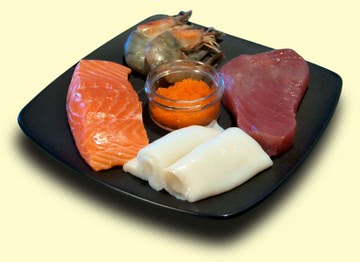
The basis for the preparation of Sushi is rice. You will find everything worth knowing about rice in the first section. Although there is Sushi without fish, the fish - mostly used raw - remains one of the most important ingredients. The different types of fish are therefore presented in an own paragraph. Next is further seafood, used often for Sushi, and last but not least a list of all other but not less important ingredients.
Rice · イネ
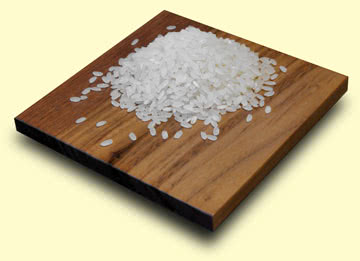
The Japanese name for rice is Kome or Gohan (ご飯) for cooked rice. You will find Sushi without fish but never without rice. The taste and the condition of the rice are of crucial meaning to the quality of Sushi. Rice, being cultivated in many regions on earth, is available in countless variations. The most suitable rice for Sushi is white, peeled short-grained rice. In no case you should use unpeeled rice. Often you see Japanese rice specially marked as rice to be used for Sushi. Not suitable is the Asian sticky rice for containing loads of starch.
Fish · 魚
Mostly used and eaten raw, fish you want to use for Sushi needs to be fresh above all. Using deep frozen fish is possible, but because of fresh fish tasting better it is not absolutely recommended. So how recognize fresh fish? To tell it with the words of a well-known German television cook: "If you shake it and the bones fall down, you should not buy it." However, it is not that easy to recognize fresh fish.
Important
Fresh water fish should not be used raw for Sushi. Especially fresh water fish may contain parasites.
The freshness of fish, if bought as a whole, shows among other things on clear, not dull and not blood shot eyes. The flesh should be firm and elastic, meaning if pressed by your fingers it should give way and, after letting go, find back in its original shape. The scales of fresh fish are shining and the gills are red. Fresh fish under no circumstances smells like fish.
Fresh fish is to be used as soon as possible, in case of needing it for Sushi that means gutting and filetting. The so prepared fish should be kept cool and be eaten soon. If you wish to store it longer than half a day you should wrap it into polythene sheet, protecting it from drying up.
In principle, nearly every fish can be used for the preparation of Sushi. Some sorts of fish indeed have turned out to be especially suited and tasty. These will be presented in the following.
Tuna (Maguro) · 鮪
Tuna is a fish related to the mackerels. It is mainly catched in the warm waters of the Atlantic and Pacific down in 200 meters depth. Nearly every part of the fish may be eaten raw. The pieces' color is dark red, reminding one of beef. Tuna is the most popular Sushi filling.
Experts prefer the fatter pieces of tuna, taken from the belly side, because of the more intensive taste. As a rule, you may say, the fatter the piece of tuna is, the better it tastes. Therefore the fat tuna flesh is subdivided into three parts: fat (toro), fatter (chu toro) and very fat (otoro). The fatter the flesh, the less dark the color is.
Tuna belongs to the fat fishes and contains up to 260 calories per 100 gram. Apart from iodine and vitamin A it is above all a supplier of valuable essential fatty acids.
Salmon (Sake) · 鮭
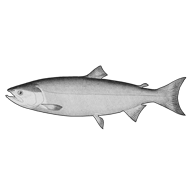
Today salmon is found mostly in the Pacific. A long time in his life the fish stays in the sea, finally searching his way against the current of a river to spawn. Traditionally the salmon is not used raw for Sushi but slightly smoked or marinated. In the meantime salmon is also used raw. The flesh is of a pale-red to orange color and tastes lightly sweet.
Salmon also contains valuable fatty acids. Furthermore its fat holds vitamines A, D, E and plenty of potassium, fluorine and iodine.
Mackerel (Saba) · 鯖
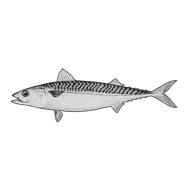
The mackerel is an oily fish with soft flesh. Best time for the mackerel is October or November, when the flesh is especially fat and tasting intensively. Although mackerel and tuna belong to the same family, they do not have very much in common regarding to the taste. In contrast to the light, unobtrusive taste of the tuna, the mackerel tastes much more intensively.
Yellowtail (Buri) · 鰤
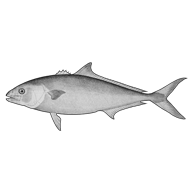
The Japanese yellowtail belongs to the spine mackerels and is closely related to the tuna. Buri, the grown-up fish, and Hamachi (ハマチ), the young fish, are of golden color and raised in Japan in special fish farms. Outside of Japan it is quite difficult to get real Japanese yellowtail.
Sea bass (Suzuki) · 鱸
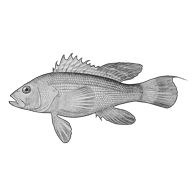
The full-grown Japanese sea bass is called Suzuki and over 60 cm long. His white flesh is especially tasty in the summer months.
Red Snapper (Tai) · 鯛
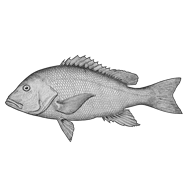
There are known more than 100 variations of this carp-similar fish. Some Japanese types are Mai-dai, Chi-dai, Kuro-dai, Ishi-dai and Renko-dai. Among the use as fish for Sushi, the Snapper is also very tasty when grilled.
Freshwater eel (Unagi) · 鰻
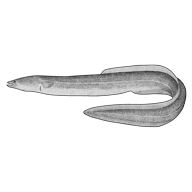
In Japan, freshwater eel is very popular in various ways of preparation and is also used as an ingredient for Sushi. Unagi is never eaten raw, but first grilled and then put into marinade. The freshwater eel is full of taste and its color is nut-brown. Being already marinated, you do not put the freshwater eel into soy sauce.
Sea eel (Anago) · 穴子
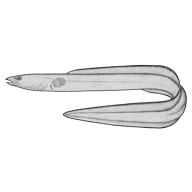
Sea eel is, similar to the freshwater eel, not used raw, but first cooked, then grilled and also marinated. Anago is a very rich source for animal fats.
Further seafood · 魚貝類
Apart from fish there is much further seafood used gladly for Sushi. Among them are shellfish and fish roe. Just like the fish the seafood should be as fresh as possible. Especially mussels should absolutely be used alive. You will know if a mussel is still alive if it is shaped evenly, does not have clefts and is closed properly. If lifted, the mussel should seem heavy. It is on no account supposed to float in the water.
In general, it is best to get the ingredients only from a merchant of whom you know sells them absolutely fresh.
Abalone (Awabi) · 鮑
The abalone is a sea-snail of the Haliotidae-family with greyish flesh that may be eaten raw. Because the flesh of the male abalone is more firmly it is preferred for making Sushi. Eaten is the suction muscle which is, like other muscle meat, very firm.
Prawn (Ebi) · 海老
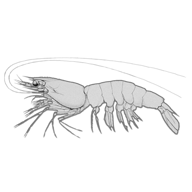
Prawns are used for Sushi either cooked (Ebi) or raw (Ama ebi (甘海老)). Especially the raw Ama ebi are agreed to be a delicacy.
Crab (Kani) · 蟹

The flesh of crab is not used raw but cooked. Usually, the king crabs from Alaska are used for Sushi. For crab being a real delicacy it is often replaced by a substitute, Surimi (すり身). The Surimi sticks are made by tradition for centuries in Japan, consisting of fish flesh, spices and starch.
Squid (Ika) · 烏賊
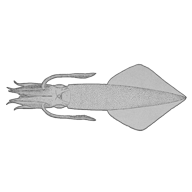
Squids are shellfish without muscles but tentacles and swim freely in the sea. They occur in different sizes, starting at a few centimeters up to several meters length. More than 80 percent of their white, shining flesh is eatable. Parts of their body are used as a layer for Sushi (Ika). In former times squids were only used cooked for Sushi or Sashimi. Modern cooling methods make it possible today to use squids also raw. The tentacles (Geso) may be grilled or used as an addition for salad.
Octopus (Tako) · 章魚
The octopus is found in the Pacific and its scarlet tentacles contain much protein. The octopus is always cooked before you cut its tentacles into thin slices. His white flesh is firm if you chew it, its taste unobtrusive.
Sea urchin roe (Uni) · 雲丹
The sea urchin is a shellfish. His roe is a delicacy. The urchin is opened at the bottom and the insides are taken out. Resting at the inner top of the shell is the roe that is eaten. The yellowish roe has a fresh, nut-like taste.
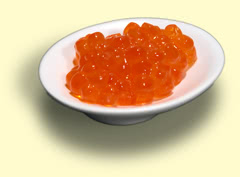
Salmon roe (Ikura) · イクラ
The big, orange salmon eggs are sometimes called red caviar and are often used for Sushi. You will know fresh salmon roe by his orange color and even surface.
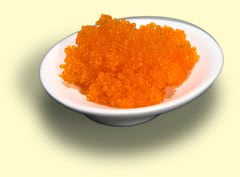
Flying fish roe (Tobiko) · とびこ
Tobiko are the small orange eggs of the flying fish, tasting mainly salty. Tobiko is also likely to be used for decorating.
Further ingredients
Vinegar (Su)
Rice vinegar undoubtedly is the most important spice concerning the preparation of Sushi. You should absolutely use rice vinegar, for wine vinegar or apple vinegar is much too intensive in taste - they would conceal every other taste. The rice vinegar is used to spice the cooked rice. You may also disinfect the raw fish with it.
Tip
You often find rice vinegar already mixed with sugar and salt called Sushi-zu that you can use especially for the preparation of Sushi.
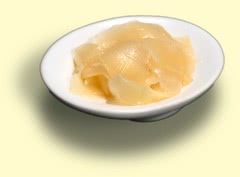
Ginger (Gari) · ガリ
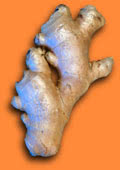
In the whole Japanese cooking, ginger plays an important role, also in preparing Sushi. Pickled ginger is always served with Sushi and normally eaten between the single bites to neutralize the taste in your mouth so that every mouthful shows to advantage.
The pickled ginger is cut in very thin slices, having a good effect on digestion and being very stimulating.
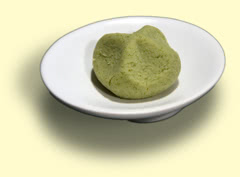
Horseradish (Wasabi) · ワサビ

Japanese horseradish is green and much more aromatic than the European one. Therefore it is not possible to replace Wasabi by European horseradish. It is nearly impossible to get fresh Wasabi here, which is rubbed delicately with a grater before using. You may find it in the form of powder or in tubes. The powder is stirred with water to a thickened paste, Wasabi being in tubes can be used instantly without further treatment. If you make Nigiri-zushi you will absolutely need Wasabi. Many people appreciate it if it is put additionally into soy sauce. Therefore you stir a small amount of Wasabi into soy sauce before serving it to Sushi. However, you should be careful with using Wasabi. Like the European horseradish, it does not leave much to be desired concerning its pungency.
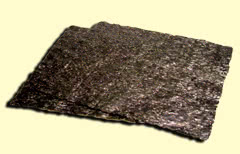
Seaweed (Nori/Kombu) · 海苔/昆布
You will need Nori (海苔) for rolled Sushi. Nori sheets are pressed from dried seaweed that was cut into small pieces. They are lightly roasted, tasting discreetly salty. Nori is also used to build a cup for the different sorts of fish eggs (Gunkan-style).
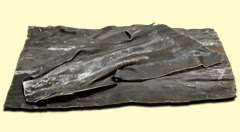
Kombu (昆布) on the other hand is a special sort of seaweed which is dried in whole pieces before being used for cooking. Kombu is rich in calcium, iodine and iron and also containing natural glutamate which intensifies the taste. You should not wash Kombu but only wipe it with a damp tea towel, as the white powder on the surface is responsible for a substantial part of the taste. Kombu contains that much iodine that you should not eat a lot of it at once.
Sesame (Goma) · ゴマ
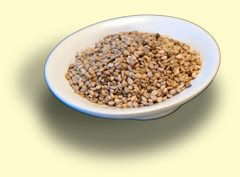
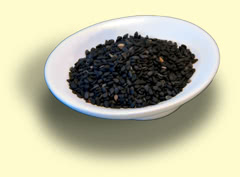
Sesame seed is used as a refinement for some Sushi. It is used above all with the different types of Maki-zushi. Together with ice cream tasting vanilla or green tea it will make a simple, delicious dessert.
Soy sauce (Shoyu) · 醤油
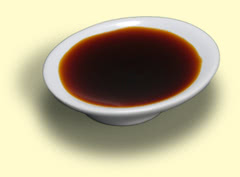
Soy sauce exists in two variations, being pale or dark. For Sushi you take the dark sauce. At the beginning of the meal you put soy sauce in a small bowl, possibly mix it with some Wasabi, and use it to dip the separate Sushi bites in.
Rice wine (Mirin) · みりん
Mirin (みりん) is a sweet wine, made out of different sorts of rice, being often used in the kitchen for marinades. There are two types of rice wine, hon mirin and shin mirin, slightly different in taste. For the preparation of Sushi you may use both.
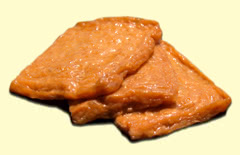
Flat cake of tofu (Abura-age) · 油揚げ
You need fried flat cakes of tofu for Inari-zushi (稲荷寿司). Therefore you sweeten the cakes and fill it with the vinegared rice.
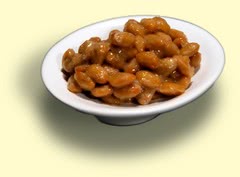
Soybeans (Nattō) · 納豆
Traditionally in Japan soybeans are packed in straw to begin fermentation under the influence of a bacterium. More modern practices just mix the beans with the isolated bacterium. The fermentation process produces nattō with a distinctive smell and lots of sticky strings when stirring.
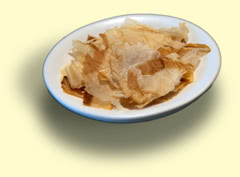
Bonito flakes (Katsuo-bushi) · 鰹節
Bonito is a fish related to the tuna. Because of its very individual taste it is hardly used for Sushi. In Japanese cooking there are the so-called bonito flakes (Katsuo-bushi) used as a spice. For making them, the bonito is cooked at first. Next it is smoked and dried several times until it has become very stiff. With a special tool the flakes are then cut off the fish. The flakes are among other things one of the two main ingredients for Dashi stock.
Shichimi tōgarashi
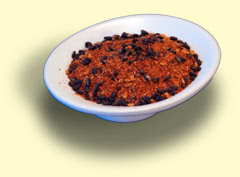
The main part of these very spicy mixed herbs is chili-pepper. Added are orange peel, seaweed and sesame seed. Togarashi is a seasoning used at the table. It gives soups and noodles a piquant touch.